10 Patient Handouts Every Clinic Should Have (2026)
The 10 essential patient handouts every clinic needs, what each one solves, and how to get them all ready this week using free templates.
You might be running clinic for dental, physical therapy, pediatrics or for some other clinic but one is sure that you need to have branded patient handouts to give to patients before they leave the appointment based upon their condition (pre care, post care, treatment guide, etc).
Visit any well-run clinic and you'll find a pattern. Patients leave with something in their hands. Not an unstructured printout grabbed in a hurry. A clear, readable document that tells them what to do next and who to call if something goes wrong.
Most clinics already hand out something. The problem is what they're handing out. Generic templates that don't match the procedure. Documents so dense that patients stop reading at the second paragraph. Or nothing at all.
Research published in the Journal of the Royal Society of Medicine found that patients forget 40 to 80% of what a doctor tells them before they reach the car. A good handout doesn't replace the conversation. It backs it up with something patients can read at home, three days later, when the questions start.
These are 10 real handout templates drawn from across the 14 specialties at ClinicsFlows. Each one was chosen because it covers a moment where patients most often leave without the guidance they need.
How to Use This List
Not every handout applies to every specialty. A pediatric practice won't use a post-knee surgery guide. A dermatology clinic won't need a tonsillectomy care sheet. Read through the 10 and match them to the procedures your patients ask the most follow-up questions about. Start with those.
The 10 Essential Patient Handouts
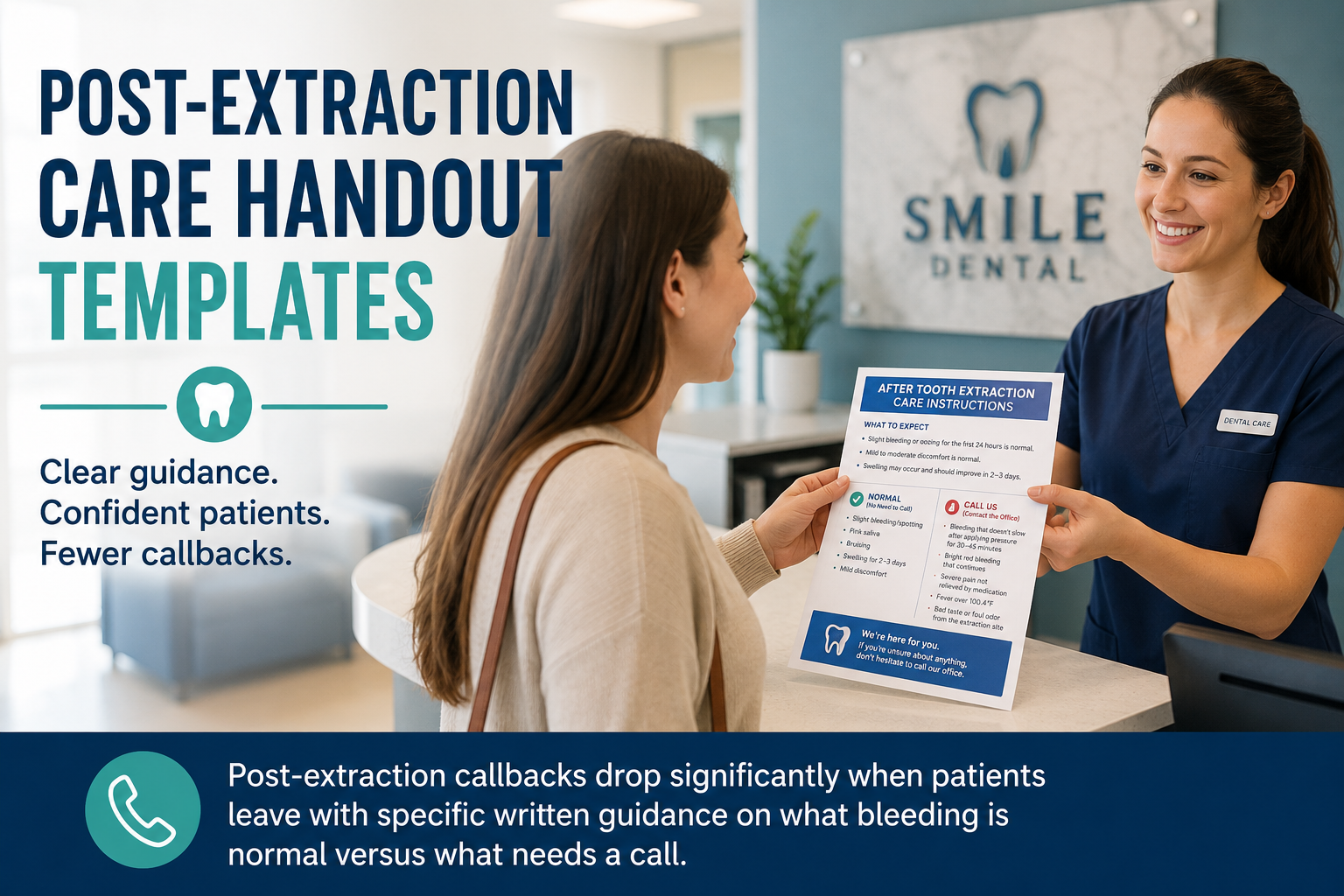
1. After Tooth Extraction Procedure: Bleeding and Recovery Care Instructions
Available in: Dental patient handout templates
Tooth extractions are one of the most common dental procedures. "Is this bleeding normal?" is one of the most frequent post-procedure callbacks that originates from them.
For the first twenty-four hours following an extraction, patients must follow precise, numbered instructions. This handout addresses socket care, dietary limitations, bleeding expectations, edema management, and when to contact back. It eliminates uncertainty and lowers nervous callbacks from patients who are unable to distinguish between a problem and normal healing.
Dental practices that give this handout at checkout report a consistent drop in after-hours calls. The information patients need is written down. They don't have to remember what the dentist said while sitting in the chair.
2. Living Well With Hypertension: Daily Management Guide
Available in: Cardiology patient handout templates
Almost half of all US adults have high blood pressure. Most have heard the advice at least once: watch your sodium, take your medication, and track your readings. A one-time verbal summary during an appointment doesn't turn into daily habits.
This chronic care guide can serve as a structured daily reference for patients. It covers at-home monitoring techniques, dietary modifications, when to take medications, and which readings call for a call. For any clinic that serves patients with hypertension, this handout integrates the instruction into the patient's everyday routine, where it really matters.
The handout is applicable to a variety of disciplines. It is used in cardiology clinics when new patients begin taking antihypertensives. Patients receive it during yearly physicals at general practices. Patients whose readings rise are given it by urgent care facilities.
3. Living Well With Chronic Lower Back Pain: Daily Management Guide
Available in: Physical therapy patient handout templates
The most frequent reason people see a physical therapist is for back pain. Additionally, persons with this illness are more likely to act appropriately in the clinic but incorrectly at home. In the absence of a written reference, at-home workouts are neglected and painful behaviors resurface in between sessions.
This handout tells the patient how to take care of themselves every day, how to move safely, what exercises to do, what situations to avoid, and what changes in their symptoms should make them call the clinic. This is the paper that PT offices use to keep patients on track between visits.
Written home care instructions are one of the best indicators of whether patients follow through between clinical visits, according to a National Institutes of Health study (https://pmc.ncbi.nlm.nih.gov/articles/PMC5242136/). When it comes to results, back pain is the condition where the gap between sessions is most evident.
4. Vaccine Injection Site Care: Soreness What to Expect After Immunization
Available in: Pediatric patient handout templates
Almost every well-child visit at every pediatric office includes a shot. At least one parent calls after almost every visit to talk about an arm pain, a low fever, or a small lump where the shot was given.
This handout tells parents what's normal after each type of vaccine, what mild reactions look like versus what needs attention, and what to do in the meantime. Given at checkout, it answers the call before it happens. Parents who leave with this handout have a reference for 9pm when the symptoms start. Clinics that give it out consistently see a clear drop in same-day callback volume.
It's also a trust-building document. Parents who feel informed after a vaccine visit are more likely to stay on schedule for future appointments.
5. After Knee Surgery: What to Expect During Recovery
Available in: Orthopedic patient handout templates
Knee replacement and knee repair are among the most common surgical procedures in orthopedic practices. Recovery takes weeks. Most patients have never done this before. They don't know what swelling is normal on day three, when they can drive again, or how to tell if the incision is healing correctly.
A clear post-surgical guide covers the day-by-day recovery timeline, activity restrictions, wound care steps, and specific warning signs that need a call or a clinic visit. It also covers medications and weight-bearing instructions that vary by procedure type.
Patients who receive this at discharge follow their recovery plan more closely. They arrive at follow-up appointments with better outcomes and fewer emergency calls in between.
6. Living Well With Major Depressive Disorder Daily Management Guide
Available in: Psychiatry patient handout templates
A patient who has just received a depression diagnosis leaves the appointment carrying a lot. They're processing a new diagnosis, a possible medication, instructions they may have only partially heard, and an uncertain road ahead.
Research published in Patient Education and Counseling found that patients retain significantly less clinical information during emotionally charged appointments. A mental health handout given at the end of the visit gives patients something concrete to return to when they're ready. This guide covers daily management strategies, medication basics if applicable, lifestyle factors that affect mood, and how to reach the clinic or a crisis resource when needed.
Mental health practices that give this handout at the time of diagnosis report better medication adherence and fewer missed follow-up appointments in the first 60 days.
7. Minor Laceration Wound Care: After Stitches and Repair Instructions
Available in: Urgent care patient handout templates
One of the most common things that urgent care clinics do is fix cuts and scrapes. Patients leave with stitches and a verbal instruction they half-remember. Two days later they're not sure if the redness around the wound is normal or infected.
This handout covers wound site care for the first days after repair, what signs of infection look like, when stitches should come out, and activity restrictions while healing. It's a one-page document patients can reference at home. It's one of the library's most influential handouts for urgent care facilities. Patients who departed without documented care instructions are most likely to return with a preventable consequence.
8. Annual Gynecologic Exam: Well Woman Visit Guide
Available in: Gynecology patient handout templates
Well-woman visits are high-volume appointments. They're also the visits where patients arrive least prepared. Many patients aren't sure what the appointment covers, what tests they'll receive, what to expect from a pelvic exam, or what questions to bring.
A pre-visit guide given at the time of scheduling or at check-in sets clear expectations before the appointment begins. It covers what the annual exam includes, which screenings are typically done by age, what to prepare before arriving, and what to do with results. Practices that send this handout before each annual visit report fewer no-shows and shorter appointment times because patients arrive knowing what to expect.
9. What to Expect After Tonsillectomy Surgery Care Guide
Available in: ENT patient handout templates
Tonsillectomies are performed across all age groups. Recovery is longer and more painful than most patients expect. Days four and five are often worse than the first two. Patients who were unaware of this call were in a panic, believing that something had gone wrong.
This handout walks through the recovery timeline day by day. It covers pain expectations at each stage, dietary restrictions, activity limits, and which symptoms are normal versus which ones need a call. The Agency for Healthcare Research and Quality recommends written patient education for all surgical procedures. Patients with written post-op instructions recover significantly better than patients who rely on verbal guidance only.
ENT practices that give this handout at discharge report fewer after-hours calls in the first week of recovery.
10. Eczema Rash Condition: Treatment Options and Your Best Choice
Available in: Dermatology patient handout templates
Eczema is one of the most commonly managed conditions in dermatology. Treatment regimens are specific and multi-step. Patients who leave without clear written guidance default to generic moisturizers that don't treat the condition.
This treatment guide explains eczema in plain language, covers the treatment options available at each severity level, and gives patients a practical daily care routine to follow. When patients understand their treatment plan and have a written reference at home, they stick to it and return with better outcomes at their next appointment.
For dermatology practices, treatment adherence is the single biggest factor in whether a chronic skin condition improves. A clear handout is one of the lowest-cost ways to move the needle on this.
How to Get All 10 Ready This Week
You don't need to write any of these from scratch. Each of the 10 handouts above is available at ClinicsFlows, already written by specialty and procedure. Add your clinic's name, logo, and phone number in the live-preview branding dialog and download a print-ready PDF.
A front desk coordinator at a 3-provider family practice worked through this list. She matched each handout to her clinic's most common callbacks. She added her clinic's branding. All 10 were downloaded and ready to print within two hours. No design work. No writing from scratch.
Browse the full library at clinicsflows.com/handouts and filter by specialty to find the handouts that match your practice first.
Frequently Asked Questions
What patient handouts should every clinic have?
The best starting point is your highest-callback procedure. What does your front desk explain by phone most often after appointments? Find a handout for that first. Post-procedure care, chronic condition management, and new diagnosis guides cover the moments where patients most often leave without the guidance they need to manage their care at home.
How often should clinic handouts be reviewed and updated?
Review clinical content once a year or whenever treatment guidelines change in your specialty. Update contact details any time they change. Storing templates in a platform like ClinicsFlows means you only update once and re-download a fresh PDF when needed.
Do patient handouts actually reduce front desk call volume?
Yes. Specific written guidance reduces the calls patients make because they can't remember verbal instructions. The reduction is most noticeable after procedure-based visits and for patients who started a new medication or received a new diagnosis.
Can I customize these templates for my specialty?
Yes. All 1,400+ templates at ClinicsFlows are organized by specialty and filterable by procedure type. Dental, physical therapy, pediatric, orthopedic, cardiology, and dermatology versions are all available at clinicsflows.com/handouts. Every template is free to brand with your clinic details.
Do I need an account to download a template?
No. Any visitor can open the branding dialog, add a logo and clinic name, and download a branded PDF without creating an account. A free account saves your clinic details so they auto-fill on every future download.
The Simplest Fix for Your Most Predictable Problem
Every missing handout is a phone call you'll take later. A patient without post-extraction instructions calls at 9pm. A patient without a hypertension management guide takes the wrong approach at home. A patient without knee surgery recovery instructions guesses.
Pick two or three from this list. Match them to your highest-volume procedures. Add your clinic's branding. Print them this week.
Browse 1,400+ free patient handout templates at ClinicsFlows, sorted by specialty and procedure. Every template is free, ready to brand, and ready to print.